A bicycle trip of 2322 km without traffic lights – from the Russian Altai Mountains in the west to Ulaanbaatar in the east – most of the time on roads that make most forest paths look like highways. I still do not understand how I managed to keep up my morale on the Mongolian dirt roads. I soon realised that I probably was the biggest attraction in Mongolia since the last visit of the Dalai Lama. A man on a heavily-loaded bicycle makes even the most busy driver or nomad stop or come riding from many kilometres to check out the phenomenon. Unfortunately, my ability to speak the Mongolian language is almost non-existent, so these meetings passed in almost the same way every time. First, we said “hello” to each other in Mongolian. After that I was asked about something, in Mongolian, and I answered with words like “Denmark” or “Ulaanbaatar”, which I thought would answer their questions. After this, the conversation died out, and we spoke a little to each other in our own languages until I got tired of the séance and continued my journey. The meetings also took place when I had erected my tent. Even when I thought I had found the most hidden and outlying spot on the whole steppe, there was always a herder who had seen me with his binoculars, who then came galloping up to me during my dinner, dress-change, toilet or other moments in the evening.
|
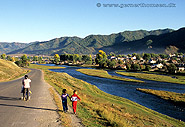 A village in Altai Mountains. |
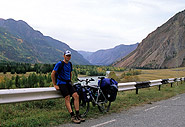 Biking in the Altai Mountains. |
 The first 500 km through Altai Mountains were peace of cake compared to the road through Mongolia. |
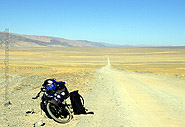 The bad Mongolian roads have just started! |
| |
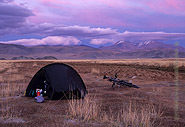 I usually stayed overnight
on the steppe in my small tent. |
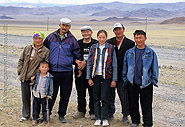 I had meetings every day with nomads and car drivers who randomly passed by. |
 Most of the Mongolian roads are unpaved and in bad condition. |
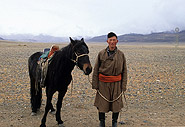 A nomad has arrived to check out who I am. |
| |
 The curious children
are on their way out
to look after sheep. |
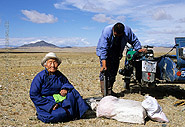 Repairing a motor bike
on the steppe. |
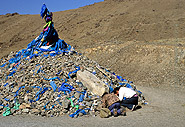 A so-called ’Ovoo’. To have good luck on your journey you need to throw a stone on the pile or to sacrifice something. |
 The wave pattern in
the roads lowers the
speed to about 10 km/h. |
| |
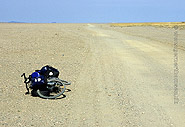 Biking through the waste and
dry land of Gov-Altai Province. |
 The shepherds use the camels
for transporting heavy loads. |
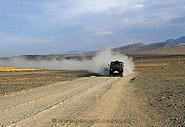 You only meet a few cars on the Mongolian roads, but when they arrive remember to be on the
right side because of the dust! |
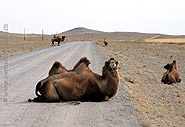 The camels are more curious than scared about the strange biker. |
| |
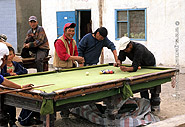 Pool is a popular game in Mongolia, even in the small villages. |
 The motorbike is a useful mean
of transport for the nomads when they have to cover the big distances between towns. |
 A rare, small pond on the dry steppe. |
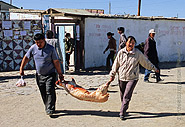 At the market in the Altai
province capital. |
| |
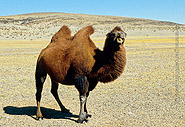 The camel’s reaction after I told him a joke. |
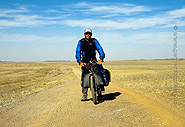 It’s easy to feel lonely in Mongolia. |
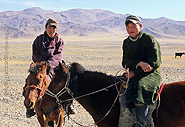 Every day I met nomads who wanted to check out what I was doing. |
 I was close to loose courage on the trip across Arkhangai Mountains – the average speed was the lowest I ever experienced on my whole trip. |
| |
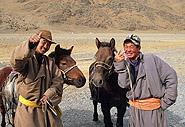 Biking through Mongolia creates smiles on your way. |
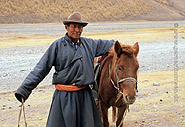 The Mongols learn to ride a
horse from the childhood. |
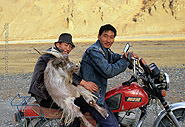 Russian motorbikes are popular among the nomads who use them for transport of almost everything. |
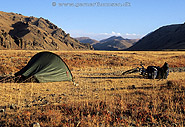 Tenting in Arkhangai Mountains. |
| |
 Many Mongols live in yurts
all the year around. |
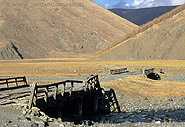 The infrastructure in Mongolia is
in extremely bad condition. |
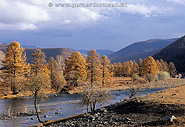 Larch trees with autumn colours. |
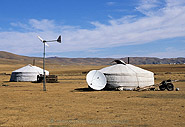 Many nomads have recently got solar energy and small wind mills which deliver electricity for TV’s
and other things. |
| |
 At some places you can find yurt camps designed for tourists. |
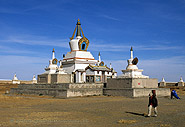 Erdene Zuu Monastery (1586) in the old capital Karakorum. |
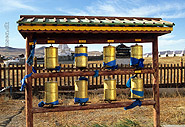 Buddhist prayer mills. |
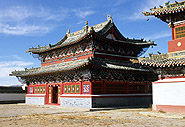 One of the temples at Erdene Zuu Monastery. |
| |
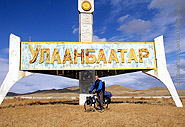 Finally...Ulaanbaatar after
2322 km on bicycle. |